

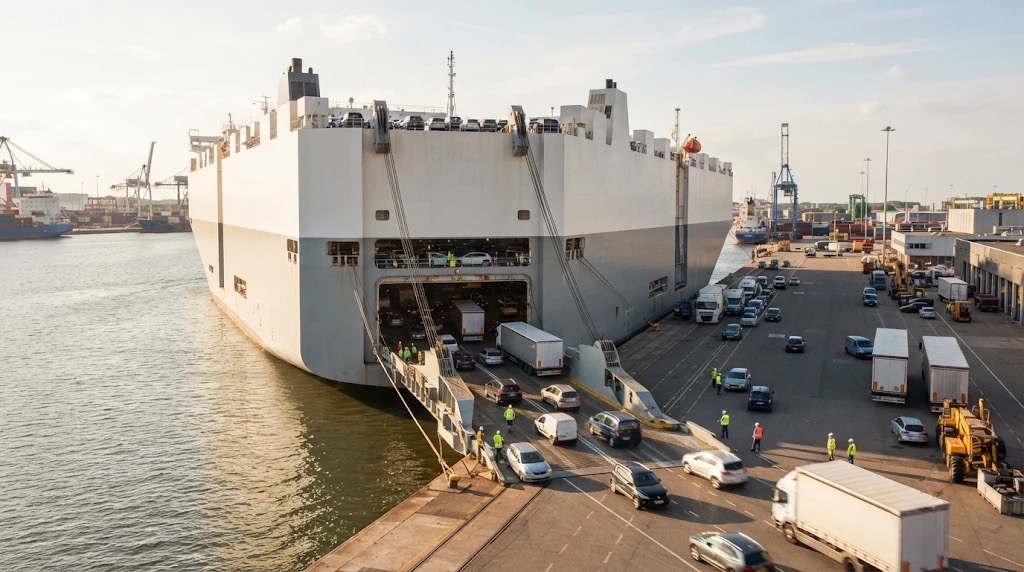
If it has wheels or tracks, there's usually a better way to ship it than stuffing it in a container: drive it on, and drive it off. RoRo (Roll-on/Roll-off) shipping is the specialised method behind most of the cars, trucks, buses and heavy machinery that arrive in Saudi Arabia — and for the right cargo it's faster, safer and often cheaper than containerised shipping. For car dealers, equipment importers and anyone moving rolling stock, understanding RoRo is understanding how to do it well.
We're BAFCO International — 30 years of ocean freight and specialised cargo across Jeddah, Riyadh and Dammam. This guide explains how RoRo shipping in Saudi Arabia works.
Ask BAFCO about RoRo shipping — vehicles and rolling cargo handled right.
What is RoRo shipping?
RoRo stands for Roll-on/Roll-off — a method where wheeled and tracked cargo is driven directly onto and off a specialised vessel via built-in ramps, rather than lifted by crane or packed into a container. RoRo vessels are essentially floating multi-deck car parks, purpose-built to carry rolling cargo securely. The cargo either drives on under its own power or is moved on a platform (like a modular transporter) for units that can't drive themselves.
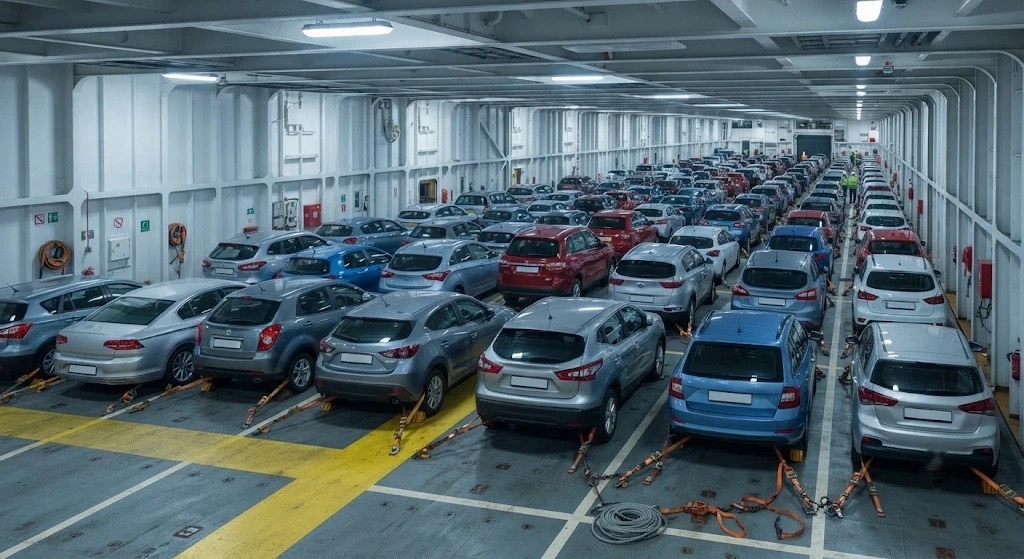
What moves by RoRo
RoRo carries anything on wheels or tracks:
- Cars and SUVs — the biggest category; RoRo is the dominant method for importing finished vehicles into Saudi Arabia.
- Trucks, buses and vans — commercial vehicles of all sizes.
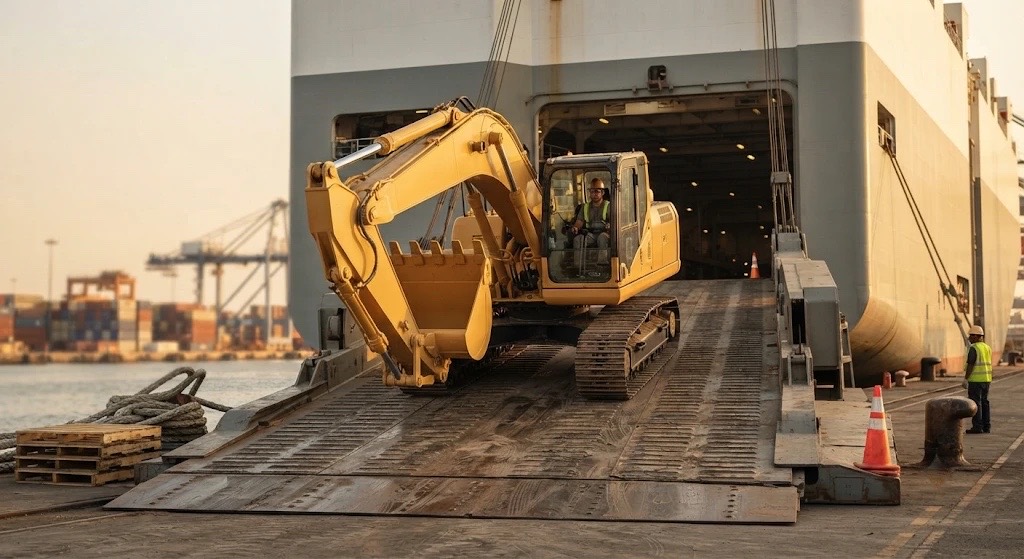
- Heavy machinery — construction and agricultural equipment, excavators, cranes, forklifts.
- Oversized units — boats, RVs, and rolling project cargo that exceeds container dimensions.
If it rolls, RoRo is usually the natural choice.
RoRo vs container shipping
| RoRo | Container | |
|---|---|---|
| How it loads | Driven on/off via ramp | Craned in, or vehicle secured inside a container |
| Best for | Running vehicles & machinery | Non-running vehicles, high-value cars, mixed cargo |
| Handling | Minimal — less damage risk | More handling; secure and enclosed |
| Cost | Often lower for standard vehicles | Can be higher, but shared for part-loads |
| Security | Open decks (vehicle only, no personal goods) | Fully enclosed and sealed |
| Oversized units | Ideal — no size constraint of a box | Limited by container dimensions |
Rule of thumb: RoRo for running, standard vehicles and machinery; container for non-running vehicles, very high-value cars you want enclosed, or when you're shipping goods alongside the vehicle.
The RoRo process, step by step
- Booking — the vehicle/unit is booked onto a RoRo sailing to the destination port.
- Delivery to origin port — the unit is delivered and inspected before loading.
- Loading — it's driven onto the vessel and secured (lashed) to the deck.
- Sea transit — the voyage to a Saudi port.
- Discharge — it's driven off at the destination port.
- Customs clearance — import formalities, duty and compliance (see below).
- Collection/delivery — the unit is collected or delivered onward.
Ports for RoRo in Saudi Arabia
The main RoRo gateways are Jeddah Islamic Port (Red Sea, the largest vehicle-import gateway), King Abdulaziz Port in Dammam (Gulf), and Yanbu on the Red Sea. The right port depends on the origin lane and where the vehicles are headed for onward distribution.
Importing vehicles into Saudi Arabia — the rules
This is the part car-shipping pages often gloss over, and it's where imports get stuck. Vehicle imports into Saudi Arabia face specific regulations: rules on vehicle age and condition, required documentation (title, invoice, conformity), SASO/SABER conformity for vehicles, and customs duty and VAT on the value. There are also restrictions on certain vehicle types. Getting the compliance right before shipping — not discovering a restriction after the car has arrived — is essential, which is why importers use a forwarder who knows the vehicle-import rules, not just the shipping.
Transit times and costs
RoRo transit depends heavily on the lane — long-haul routes (for example from the US) commonly run around 25–40 days, while regional lanes are much shorter. On cost, RoRo is often similar to or lower than container shipping for a standard running vehicle, with the advantage of minimal handling. But for oversized units that simply won't fit a container, RoRo isn't just cheaper — it's the only practical option. Treat any rate as indicative and confirm at booking, as vehicle-shipping rates move with capacity and season.
Preparing a vehicle for RoRo
A few practical points that avoid problems: the vehicle should be running and driveable (RoRo needs it to move under power or be safely maneuvered); it should have only a small amount of fuel; and, importantly, RoRo generally doesn't allow personal goods packed inside the vehicle (that's a container-shipping option). The unit should be clean (some ports require it) and documented. A forwarder briefs you on the exact requirements for your lane and destination.
Shipping a vehicle by container — the options
When container is the right call, there are two common methods. Sole-use — the vehicle has a container to itself: maximum protection, highest cost. Shared/consolidated — the vehicle shares a container with others or with goods, lowering the cost. High-value cars typically go sole-use in a fully enclosed container, sometimes on a rack that lets two vehicles share a 40ft box safely. A forwarder matches the method to the vehicle and budget — and, importantly, handles the securing (chocking and strapping) that stops movement in transit. Container is also the route if you want to ship parts or personal effects with the vehicle, which RoRo doesn't allow.
Documents you need to ship a vehicle to Saudi Arabia
Vehicle imports are documentation-heavy, and missing paperwork is where shipments stall. You'll typically need the original title/ownership document, the commercial invoice or bill of sale, the Bill of Lading, and conformity/SABER documentation, plus any export paperwork from the origin country. Saudi Arabia also applies vehicle age and specification rules, and some vehicle types are restricted — so the compliance check belongs before you ship, not after the car arrives at Jeddah. This is precisely the part a specialised forwarder manages so a valuable vehicle doesn't sit blocked at the port.
Who uses RoRo shipping in Saudi Arabia
RoRo serves a broad set of shippers. Car dealers and importers bringing in finished vehicles at volume are the biggest users, relying on RoRo's speed and cost for regular consignments. Construction and industrial businesses move excavators, loaders, cranes and other rolling plant. Individuals relocate personal vehicles. And project and energy operators move rolling equipment as part of larger scopes. Whatever the profile, the common need is the same: reliable sailings, careful handling, and — the part that catches people out — smooth Saudi vehicle-import compliance on arrival.
Common RoRo mistakes to avoid
The recurring errors on vehicle shipments: not checking import eligibility (age, type, specification) before shipping; leaving personal goods in a RoRo vehicle (generally not allowed, and a customs problem); too much fuel in the tank; incomplete documentation; and underestimating clearance so the vehicle accrues port charges on arrival. Every one is avoidable with a forwarder who briefs you on the requirements up front and handles the Saudi-side compliance.
Booking and lead time
RoRo sailings run on schedules, and space — especially on popular lanes and around peak demand — can be limited, so booking ahead matters. Build in time for the vehicle to reach the origin port, the sea transit for your lane, and Saudi clearance on arrival. As with any ocean freight, the shippers who plan the timeline backwards from when they need the vehicle avoid the expensive rush of chasing scarce space at the last minute.
Vehicle condition, inspection and protection in transit
Because RoRo decks are open (vehicle-only, no enclosed box), a few sensible precautions protect your vehicle. Before shipping, photograph and document the vehicle's condition so there's a record if a claim is ever needed, remove or secure loose external fittings, and note the fuel level. On arrival, inspect before you accept — check against your pre-shipment photos and note any issue on the delivery paperwork immediately, as that record is what supports a claim. For higher-value vehicles, container shipping's enclosed protection is worth the premium precisely because it removes exposure to weather and handling on an open deck.
Insurance for vehicle shipping
Vehicles are high-value cargo, and the carrier's liability — as with all freight — is limited. Marine cargo insurance sized to the vehicle's value covers the gap, protecting against loss or damage in transit whether by RoRo or container. For dealers importing at volume, an annual/open policy covers every consignment automatically; for a one-off vehicle, single-transit cover does the job. Either way, insuring a valuable vehicle for a small percentage of its value is far cheaper than absorbing a loss — see our cargo insurance guide.
Used vs new vehicle imports: the eligibility rules
Before booking any sailing, check that the vehicle can actually be imported. Saudi Arabia applies age and condition limits to used vehicles — older cars are commonly restricted, and confirming the current rule for your specific vehicle before you ship avoids an expensive dead end at the port. Beyond age, some categories are simply not permitted — salvage or flood-damaged vehicles, certain heavily modified cars, and right-hand-drive vehicles among them — and specification rules (lighting, emissions and other standards) apply through SASO/SABER conformity. New vehicles are more straightforward but still need full conformity and documentation. The safe habit is to verify eligibility first, because a vehicle that clears the dock only to fail an import rule is the most expensive outcome in the whole process.
Duty, VAT and the cost of importing a vehicle
Two charges sit on top of the shipping cost. Saudi Arabia applies the GCC common external tariff, so vehicles typically attract a customs duty of around 5% on the CIF value (the vehicle's value plus insurance and freight), and then 15% VAT applies on top of the duty-inclusive value. Add the RoRo (or container) freight itself, port handling and clearance, and you have the landed cost. Because duty and VAT are calculated on value, an accurate declared value and the right classification matter. Treat every figure here as indicative — ask BAFCO for a live quote based on your vehicle, its value and the lane, as rates and rules can change. Building the duty and VAT into your landed-cost estimate up front, rather than discovering them on arrival, avoids an unwelcome surprise at the port.
Choosing the right RoRo lane and port
RoRo runs on scheduled sailings along set lanes, so the right choice depends on where the vehicle is coming from and where it's headed in the Kingdom. Jeddah Islamic Port on the Red Sea is the largest vehicle-import gateway and the natural choice for onward distribution to the west and centre; King Abdulaziz Port in Dammam serves the Eastern Province and Gulf-origin lanes; and Yanbu covers the north-west Red Sea coast. Matching the origin lane to the right Saudi port — rather than defaulting to one gateway — can shorten both the sea leg and the inland move to the final destination. A forwarder with all three ports in reach places each consignment where it clears and distributes most efficiently. Sailing frequency also varies by lane — busy routes run often, while thinner lanes may sail only every few weeks, and some origins transship via a hub port, adding a few days — so on less-frequent routes, booking space well ahead and confirming the next available sailing before the vehicle reaches the origin port keeps the whole timeline tight.
Why BAFCO for RoRo shipping in Saudi Arabia
BAFCO handles RoRo and vehicle cargo end to end — booking the sailing, managing the port handling, and — crucially — the Saudi vehicle-import compliance and customs that trip up less experienced shippers, with delivery across Jeddah, Riyadh and Dammam. Thirty years, in-house customs, owned terminals. Compare us in our 10 best freight forwarders in Saudi Arabia guide.
Frequently asked questions
What is RoRo shipping?
Roll-on/Roll-off shipping — a method where wheeled or tracked cargo (cars, trucks, machinery) is driven directly onto and off a specialised vessel via ramps, rather than being lifted by crane or packed into a container.
What is the difference between RoRo and container shipping?
RoRo drives running vehicles and machinery on and off with minimal handling and often lower cost, but the decks are open (vehicle only, no personal goods). Container shipping fully encloses and secures the vehicle — better for non-running or very high-value cars, or when shipping goods alongside — but usually costs more and involves more handling.
Which is cheaper, RoRo or container, to Saudi Arabia?
For a standard running vehicle, RoRo is often similar to or cheaper than container shipping, with less handling. For oversized units that won't fit a container, RoRo is the only practical option.
How long does RoRo shipping to Saudi Arabia take?
It depends on the lane — long-haul routes such as from the US commonly take around 25–40 days, while regional lanes are much shorter.
What are the rules for importing a vehicle into Saudi Arabia?
Vehicle imports face specific regulations including vehicle age and condition rules, required documentation, SASO/SABER conformity, and customs duty and VAT — with some vehicle types restricted. Confirm compliance before shipping.
Related reads
- Ocean / Sea Freight Services in Saudi Arabia
- Machinery Shipping in Saudi Arabia
- Project Cargo in Saudi Arabia (2026)
- How to Import Goods into Saudi Arabia (2026)
- Sea Freight from Saudi Arabia (2026)
- Guide to Freight Forwarding Services in Saudi Arabia
Shipping vehicles or machinery? Ask BAFCO about RoRo
Tell us what you're moving and from where — we'll book the RoRo sailing, handle the port operations, and manage the Saudi vehicle-import compliance and customs, then deliver across the Kingdom. That's RoRo shipping in Saudi Arabia handled end to end, on one accountable chain.
📞 +966 12 642 0333 · 📧 inquiry@bafcointl.com · 🚗 Ask BAFCO about RoRo shipping
📍 Jeddah HQ · Branches in Riyadh, Dammam & Jubail
